The decision affects more than how the final product looks. It shapes how long the logo lasts, what it costs per piece, which fabrics work, and whether your staff looks polished after six months of weekly washing or six weeks. Get it wrong, and you're either overpaying for durability you didn't need or underinvesting in uniforms that'll look worn out before the year is over.
Here's what you need to know to make the right call.
Key Takeaways
- Logo fusion (heat transfer) bonds a printed design to fabric using heat and pressure, with no thread or stitching involved
- Embroidery stitches the logo directly into the fabric using colored thread, producing a raised, tactile finish
- Logo fusion handles complex, colorful designs well but can crack or peel with frequent washing
- Embroidery costs more per piece but delivers significantly longer durability, often outlasting the garment itself
- Let garment type and wash frequency guide your choice — not just design preference
Logo Fusion vs Embroidery: Quick Comparison
Not sure which method fits your project? Here's a side-by-side breakdown of the key differences.
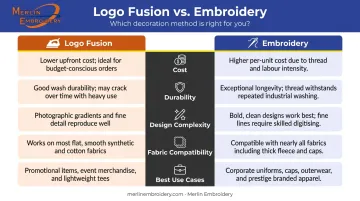
| Factor | Logo Fusion | Embroidery |
|---|---|---|
| Cost | Lower per-unit cost; minimal setup for most methods | Higher per-piece cost; design digitizing adds initial setup |
| Durability | Can crack, peel, or fade with repeated washing | Thread stitched into fabric resists fading and peeling |
| Design Complexity | Handles gradients, photos, and unlimited colors | Best for clean, bold logos; fine details and gradients are difficult |
| Fabric Compatibility | Works on flat cottons, polyesters, and blends | Best on structured, heavier fabrics; may pucker on lightweight materials |
| Best Use Cases | Event tees, promotional items, large back graphics | Uniforms, polos, hats, jackets, scrubs, corporate apparel |
What Is Logo Fusion?
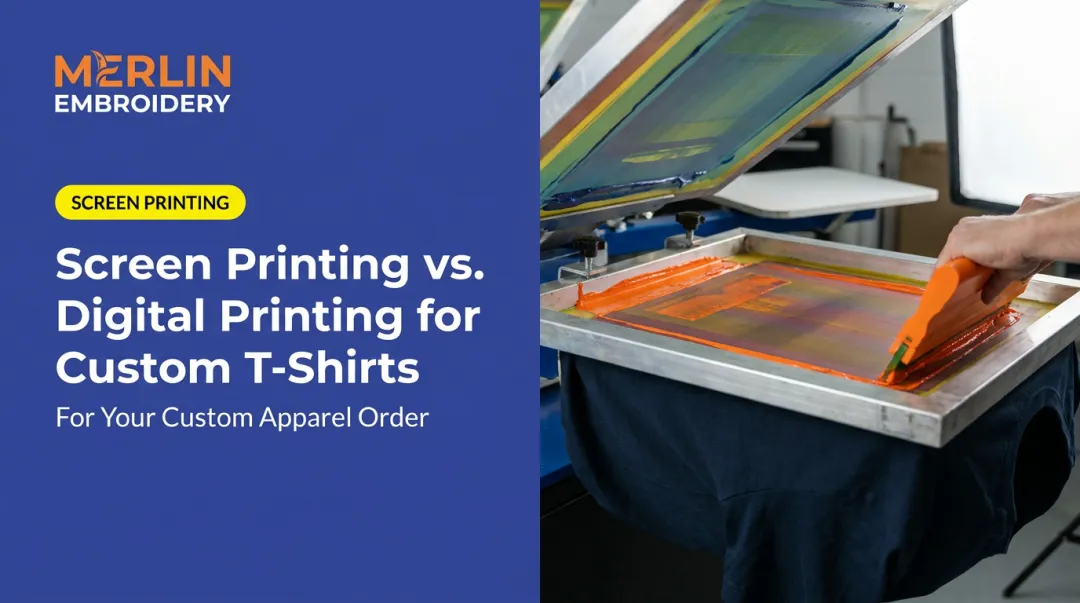
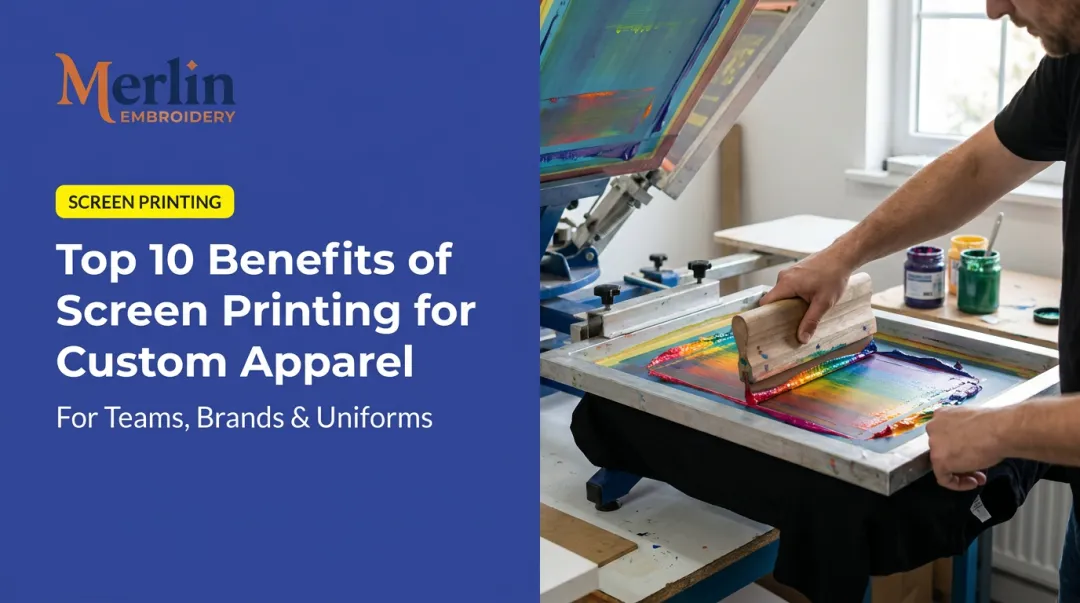
Logo fusion — also called heat transfer printing or heat press printing — is a decoration method where a design is digitally printed onto special transfer film, then bonded to the garment's surface using heat and pressure.
How the Process Works
- Design is printed onto transfer media (paper or film)
- Transfer is positioned on the garment
- Heat press applies controlled heat and pressure
- Adhesive bonds the design to the fabric surface
The result is a smooth, flat print that sits on top of the fabric rather than being woven into it. According to ASI, DTF (direct-to-film) — one of the most popular heat transfer formats today — supports full-color printing and fine detail reproduction, making it capable of handling designs that would be impossible to replicate in thread.
Photographic images, color gradients, intricate illustrations — all are achievable without the limitations of stitch count or thread color matching. For designs that live and die by color accuracy, that's a meaningful advantage over embroidery.
The Key Limitation
Because the design sits on top of the fabric, it's more vulnerable than a stitched logo. Transfer Express documents that incorrect application temperature or pressure can prevent proper curing and lead to peeling. Siser notes that excessive pressing dries the material and makes it more prone to cracking over time. Even correctly applied transfers can degrade under frequent high-heat laundering.
Where Logo Fusion Works Best
- Large-scale event merchandise (charity runs, company picnics, school spirit days)
- Promotional t-shirts intended for short-term or one-time use
- Back-of-garment graphics that are too large for embroidery to be cost-effective
- Designs with gradients, photography, or more than 6-8 colors
- Fan gear and spirit wear requiring vibrant, full-color graphics
What Is Embroidery?
Embroidery is the process of stitching a logo directly into fabric using colored thread, guided by a digitized version of the artwork that programs the machine stitch by stitch.
How the Process Works
- Logo is digitized — converted into a machine-readable stitch file that specifies stitch type, direction, density, and sequence
- Thread colors are selected to match the brand's palette
- Computerized embroidery machine stitches the design into the garment
The finished result is raised, textured, and three-dimensional. Unlike a flat print, that texture signals quality at a glance — which is why embroidered logos have been the standard for corporate uniforms and professional apparel for decades.
Why Embroidery Lasts
The durability advantage is real. Madeira confirms that polyester embroidery thread resists fading and bleach and is appropriate for frequent or commercial laundering. Because the design is part of the fabric itself rather than applied to the surface, it doesn't crack, peel, or lift under repeated washing.
Merlin Embroidery's computerized high-speed equipment delivers that consistency across orders from 12 pieces to 1,200.
Design Limitations to Know
Embroidery isn't suited for every logo. Fine details, thin letterforms, and color gradients don't translate well into thread. A Graphics Pro article based on Ricoma's guidance identifies approximately 3 mm as a lower threshold for small lettering. Logos should be bold and clean, with clearly defined shapes and no hairline detail work.
Where Embroidery Works Best
- Corporate polo shirts, button-downs, and dress shirts
- Staff uniforms across hospitality, healthcare, and field services
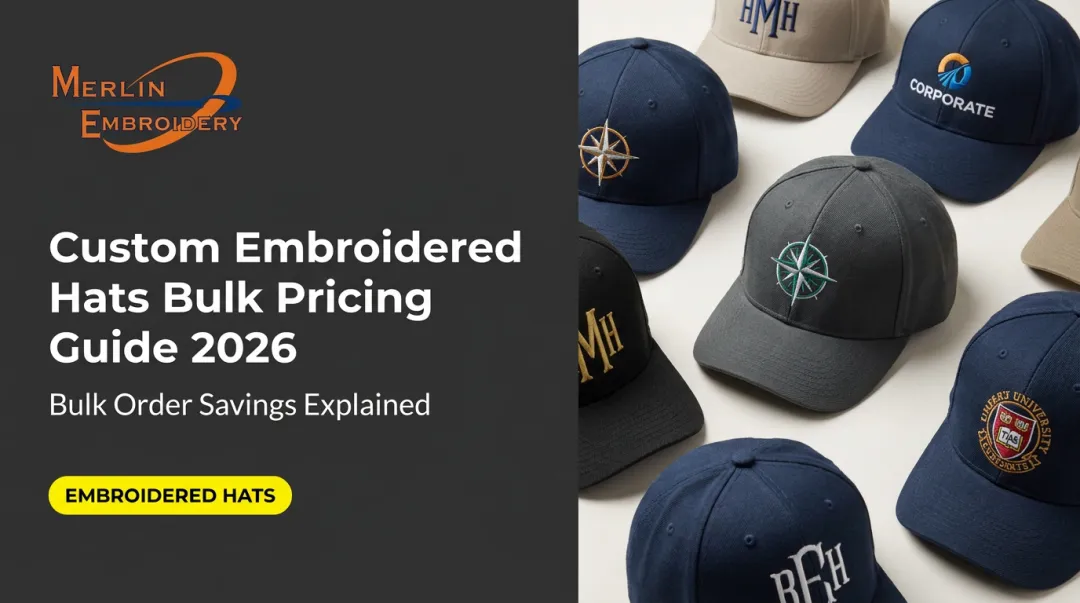
- Hats and structured caps
- Jackets and outerwear
- Healthcare scrubs
- School apparel worn daily or weekly
Industries that rely most heavily on embroidery — corporate offices, restaurants, medical facilities, schools, construction companies — share a common requirement: a professional appearance that holds up through months of regular use.
Which Method Should You Choose?
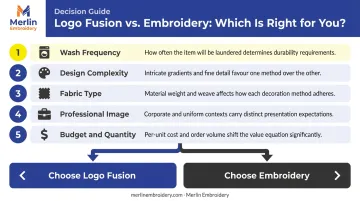
Five factors should drive this decision:
- Wash frequency — How often will the garment be laundered?
- Design complexity — Does your logo have gradients, photos, or fine detail?
- Fabric type — Is it a structured polo or a lightweight event tee?
- Professional image — What impression do you need the finished garment to make?
- Budget and quantity — What's the cost-per-piece tolerance for this order?
Cost Considerations
Each factor above carries a different weight depending on your order. Budget often tips the decision most quickly. Logo fusion generally has a lower per-unit cost, particularly for large, multi-color designs where high stitch counts push the price up. Embroidery involves a digitizing step — converting your logo into a stitch file — which adds an initial setup cost but is a one-time investment. After that first run, re-orders use the same file.
For high-volume colorful print runs, logo fusion wins on upfront cost. For uniforms that need to last a year or more, embroidery's durability makes it the better long-term value. Because pricing varies by design complexity, garment type, and order size, getting a direct quote is the most reliable way to compare costs for your specific project.
Fabric-Driven Decisions
- Smooth, flat fabrics (t-shirts, lightweight casual tees): better suited to logo fusion
- Structured, heavier materials (polos, hats, canvas bags, denim jackets): better suited to embroidery, which holds stitches cleanly without puckering
Lightweight or highly stretchy fabrics present challenges for both methods — heat transfers need proper product selection to prevent dye migration on polyester, while embroidery on stretch fabrics requires appropriate backing to avoid distortion.
A Practical Scenario
A restaurant outfitting its front-of-house team in branded polo shirts will get far more mileage from embroidery. After six months of weekly washing, a stitched logo looks the same as day one. That same restaurant ordering t-shirts for a one-day staff event? Logo fusion is perfectly adequate — the shirts serve their purpose without the added investment in thread-based durability.
The right method depends entirely on what you're asking the garment to do — and for how long.
Conclusion
There's no universal winner here. Logo fusion and embroidery each fill a specific role in custom apparel decoration — one excels at colorful, detailed, short-term applications, the other at durable, professional, frequently worn garments.
The simplest way to decide: if the garment will be washed more than a dozen times, embroidery is almost always the right call. If the design has gradients or photographic detail and the item is for a one-time event, logo fusion makes more sense.
For businesses in San Diego and the surrounding area, Merlin Embroidery has spent over 30 years matching the right decoration method to the right garment — from corporate polos and healthcare scrubs to custom printed event apparel. With a 4.9-star rating across 135+ reviews, a 5–10 day turnaround, and pricing that runs 20–25% below most competitors, they can provide a quote tailored to your specific logo, fabric, and order size.
Reach out at 619-884-9712 or merlinemb@gmail.com to get started.
Frequently Asked Questions
What does logo fusion mean?
Logo fusion (also called heat transfer printing) is a method where a design is printed onto transfer film or paper, then bonded to a garment's surface using heat and pressure. The design sits on top of the fabric rather than being stitched into it.
Logo fusion vs embroidery — which is better and which is cheaper?
Neither is universally better. Logo fusion typically costs less upfront and suits colorful or complex designs for casual or short-term use. Embroidery costs more per piece but delivers superior durability and a professional finish for uniforms and frequently worn apparel.
Can anyone embroider a school logo?
School logos can be embroidered, but most districts and universities require written approval or licensing before their marks appear on apparel. An embroidery shop can handle the stitching once that authorization is in place.
Which method is more durable for work uniforms?
Embroidery is the more durable choice. Because the design is stitched into the fabric, it resists cracking, peeling, and fading through repeated industrial washing. Heat transfer logos can degrade faster under heavy or high-heat laundering.
Does logo fusion crack or peel over time?
It can, particularly with high-heat drying or on stretchy fabrics. Proper care — washing inside out, cold water, low-heat drying — significantly extends the life of heat transfer prints.
What types of garments work best with embroidery?
Structured, medium-to-heavyweight garments hold stitches cleanly without distortion — think polo shirts, hats, jackets, canvas bags, and denim. Lightweight or highly stretchy fabrics are less suited to embroidery without specialized backing.