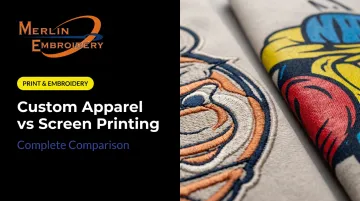
The choice matters more than people realize. Use the wrong method and you end up with puckered logos on thin fabric, cracked ink on daily-wear uniforms, or a per-unit cost that blows the budget on a 12-piece order. Get it right, and your branded apparel looks sharp, lasts, and actually reflects the quality of your business.
This guide breaks down exactly how each method works, where each performs best, and how to make the right call for your specific project — whether that's corporate uniforms, event shirts, or team headwear.
Key Takeaways
- Embroidery stitches thread into fabric — ideal for structured items like polos, hats, and jackets needing a premium look
- Screen printing layers ink onto fabric — most cost-effective for large runs of t-shirts and casual apparel with bold designs
- Embroidery won't crack, peel, or fade; screen printing covers more color range and larger graphic areas
- Screen printing setup costs make small runs expensive — embroidery's digitizing fee is a one-time charge per design
- Your decision should factor in garment type, design complexity, quantity, and intended use — price alone rarely tells the full story
Custom Apparel Embroidery vs Screen Printing: Quick Comparison
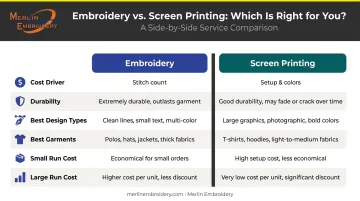
Here's how embroidery and screen printing compare across the factors that matter most when choosing between them.
| Factor | Embroidery | Screen Printing |
|---|---|---|
| Cost Driver | Stitch count + design complexity | Setup cost per color + quantity |
| Durability | Thread stitched into fabric; won't crack or peel | Ink on surface; durable when properly cured |
| Best Design Types | Logos, text marks, clean graphics | Bold graphics, large prints, solid colors |
| Best Garments | Polos, hats, jackets, fleece, button-downs | T-shirts, sweatshirts, tote bags |
| Small Run Cost | More predictable — one-time digitizing fee | Expensive — screen setup applies per color |
| Large Run Cost | Scales with complexity, not quantity alone | Per-unit cost drops significantly with volume |
What Is Custom Apparel Embroidery?
Embroidery uses a machine to stitch thread directly into the fabric, following a digitized version of your logo or design. Before any stitching begins, your artwork goes through a process called digitizing — converting the image into a stitch file that tells the machine exactly where to place thread, in what color, and in what stitch type.
According to Impressions Magazine, digitizing isn't a simple automated conversion. A skilled digitizer determines stitch placement and sequence for both the design and the specific material it will be applied to. That distinction matters: poor digitizing produces uneven stitching or designs that don't hold up.
Why Embroidery Reads as Premium
The raised, textured finish of embroidery signals permanence and quality in a way flat ink simply doesn't. That's why it's become the standard decoration method for corporate uniforms, branded polos, healthcare workwear, and structured headwear.
The durability goes beyond looks. Because the design is integrated into the fabric rather than applied on top, embroidered logos withstand repeated washing and daily wear without degrading.
Merlin Embroidery, based in La Mesa, CA, applies embroidery across a well-established range of garments: polo shirts, structured caps, button-down shirts, fleece jackets, medical scrubs, safety wear, and outerwear — working with brands including Port Authority, Nike, Columbia, New Era, Yupoong, and Flexfit.
Embroidery Stitch Variations
- Flat/standard embroidery — the most common type; works for most logo placements on shirts, jackets, and bags
- 3D puff embroidery — a foam backing raises the design off the fabric; popular on structured caps and bold text logos
- Appliqué — fabric pieces are sewn onto the garment; used for larger coverage areas where full stitching would be too dense or heavy
Best Garments and Industries for Embroidery
Embroidery works best on garments with enough structure to hold stitches without puckering:
- Structured baseball caps and trucker hats
- Polo shirts and button-down shirts
- Fleece jackets and outerwear
- Bags and accessories
- Scrubs and healthcare uniforms
Industries where embroidery dominates: corporate offices, healthcare facilities, restaurants and hospitality, and any team needing a professional uniform look. With over 30 years serving San Diego and Los Angeles businesses, Merlin Embroidery has built its reputation in exactly these markets using high-speed computerized embroidery machines that produce consistent, precise results at scale.
What Is Screen Printing for Custom Apparel?
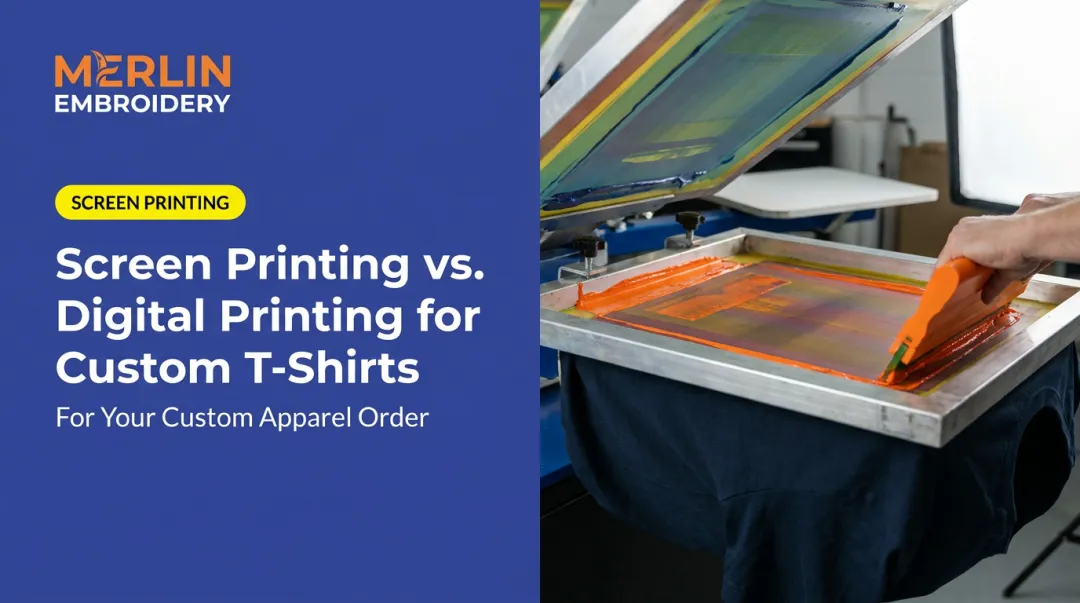
Screen printing pushes ink through a mesh stencil onto the fabric using a squeegee. Each color in the design requires a separate screen and a separate pass. Once all colors are applied, the ink is heat-cured to bond it to the fabric permanently.
Screen setup costs are fixed per color, regardless of how many pieces you print. Once screens are made, the per-unit cost drops sharply with volume — which is why screen printing became the standard for large-batch custom t-shirts, event apparel, and merchandise runs.
According to Grand View Research's March 2024 report, the U.S. decorated apparel market was valued at $5.11 billion in 2023, with the screen-printed apparel segment projected to grow at 14.8% CAGR from 2024 to 2030 — a clear indicator of how dominant screen printing remains for high-volume applications.
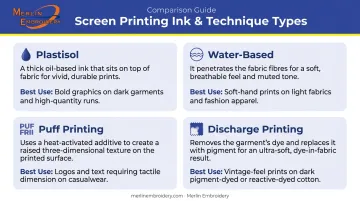
Ink Types and Specialty Techniques
| Ink/Technique | What It Does | Best Used For |
|---|---|---|
| Plastisol | High opacity, excellent wash fastness after heat curing | Dark garments, bold graphics, standard runs |
| Water-based | Softer hand, more breathable, integrates with fibers | Light garments, comfort-focused apparel |
| Puff printing | Puff additive expands under heat for a raised effect | Accent text, dimensional logos |
| Discharge printing | Removes garment dye, replaces with pigment | Soft, vintage look on 100% cotton |
Merlin Embroidery uses an M&R automatic press for screen printing — the same press format used by professional print shops running high-volume production.
Best Garments and Scenarios for Screen Printing
Screen printing requires a flat, smooth surface for clean ink transfer. It works best on:
- Event and fundraiser t-shirts
- School spirit wear and team jerseys
- Promotional merchandise in large quantities
- Sweatshirts and hoodies
- Tote bags
Screen printing handles bold logos, typography, geometric graphics, and designs with 1–6 solid colors exceptionally well. For photorealistic images or heavy gradients, direct-to-garment (DTG) printing is the better choice — each screen locks in one flat color, so continuous tones and fine gradients don't translate cleanly.
Embroidery vs Screen Printing: Which Is Better for Your Needs?
There's no universal winner here. The decision comes down to five variables: garment type, design complexity, order quantity, intended use, and budget. Choosing the wrong method for the garment wastes money and delivers a lower-quality result.
Choose Embroidery When:
- The garment is structured — a polo, hat, jacket, or button-down
- The design is a clean logo or text mark (not a photographic image)
- The apparel will be worn repeatedly as a daily uniform
- The goal is a professional appearance for corporate, healthcare, or hospitality use
- Durability through frequent washing is a priority
Choose Screen Printing When:
- The order is a large run of flat garments like t-shirts or sweatshirts
- The design is bold, graphic, or spans a large print area
- The end use is a one-time event, fundraiser, or promotional campaign
- Per-unit cost needs to stay low across a high quantity
When to Use Both
Some programs work better combining methods. A common example: screen-printed event t-shirts for attendees paired with embroidered branded polos for staff. The staff gets a premium uniform; the event gets cost-effective, high-volume branded shirts.
Working with a provider experienced in both methods means the recommendation is based on what actually fits your design, garment, and quantity — not on which service is more convenient to produce. Merlin Embroidery has handled both embroidery and screen printing for San Diego businesses for over 30 years, and can help you sort out the right approach before any order is placed.
Frequently Asked Questions
What's better for custom apparel: direct-to-garment (DTG) or screen printing?
DTG is better for small runs with complex, full-color designs — no screen setup is required, making it cost-effective at low quantities. Screen printing is more economical for large runs with simple, solid-color graphics. Both serve distinct use cases and neither replaces embroidery, which uses thread rather than ink.
What does "custom apparel printing" mean?
Custom apparel printing means applying a design, logo, or text onto a garment using methods such as screen printing, DTG, or DTF. In common usage, the term often includes all decoration methods — embroidery included — even though embroidery uses thread rather than ink.
Which lasts longer: embroidery or screen printing?
Embroidery generally outlasts screen printing because the design is stitched into the fabric and cannot crack or peel. Professional screen printing is durable when properly cured, but embroidery is the stronger choice for garments worn daily or washed frequently.
Is embroidery or screen printing better for hats and polos?
Embroidery is the standard for hats and polos. The structured fabric holds stitches without puckering, and the raised, textured result matches the professional look these garments are designed to project. Screen printing on structured headwear is technically difficult and rarely recommended.
What is the minimum order quantity for screen printing vs. embroidery?
Minimums vary by supplier. Screen printing becomes cost-effective at higher quantities because setup costs per color are fixed; embroidery's one-time digitizing fee makes it workable at smaller quantities. Both methods reduce per-unit cost as order size grows.
How do I choose between embroidery and screen printing for my business?
Start with the garment type and intended use: embroidery for structured, professional workwear; screen printing for large runs of casual or event apparel. Consulting a provider experienced in both — like Merlin Embroidery in La Mesa, CA — ensures the recommendation fits your actual design, quantity, and budget before production begins.