That makes sense — because the cost range is genuinely wide. A simple left-chest logo on a polo for a small order looks nothing like the quote for a full-back jacket design across 200 units. Stitch count, design complexity, garment type, order quantity, and a few easily overlooked fees all shape the final number.
This guide breaks down 2026 price benchmarks, the key cost drivers behind every quote, and practical tips for budgeting accurately — whether you're ordering 10 team shirts or 500 corporate uniforms.
TL;DR
- Per-item embroidery cost in 2026: roughly $6–$14 for decoration only (excluding the garment), depending on stitch count and order size
- Biggest pricing driver: stitch count — not logo size; a dense 15,000-stitch design costs more than a larger but simpler 5,000-stitch one
- Bulk pricing kicks in at 50+ pieces — small runs of 1–12 items carry the highest per-unit cost
- Don't overlook the digitizing fee: a one-time charge of $30–$75 per design that many first-time buyers miss until checkout
How Much Does Custom Embroidery Cost in 2026?
Custom embroidery doesn't have a fixed price. Two logos that look similar in size can produce very different quotes depending on design density, thread color count, and the garment being decorated.
The most common budgeting mistake: focusing only on the per-item fee while forgetting digitizing, garment blanks, or specialty placement surcharges. The second most common mistake is assuming bulk pricing always saves money. It does reduce per-item cost, but complex high-stitch designs still carry higher base costs regardless of quantity.
Typical Price Ranges
These ranges reflect decoration cost only and exclude the garment price unless purchased through the embroidery provider.
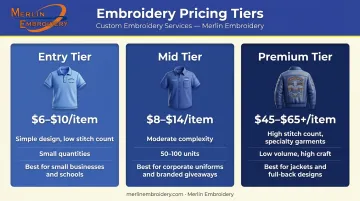
| Tier | Per-Item Cost | Best For |
|---|---|---|
| Entry (simple design, low stitch count, small qty) | $6–$10 | Small businesses, schools, teams with a clean logo |
| Mid (moderate complexity, 50–100 units) | $8–$14 | Corporate uniforms, hospitality staff, branded giveaways |
| Premium (high stitch count, specialty garments) | $45–$65+ (decoration) | Jackets, full-back designs, executive merchandise |
Real-world pricing from live provider tables confirms these ranges:
- PrintCo charges $9.60/item for 4,000–5,999 stitches at 1–11 pieces, dropping to $7.60 at 12–71 pieces
- Sport Stitch lists $8/item for up to 8,000 stitches at 1–5 pieces, or $6 each at 6–72 pieces
- Coastal Threads charges $45 under 20,000 stitches, $55 under 25,000, and $65 under 30,000 on customer-supplied garments
Key Factors That Affect Custom Embroidery Pricing
Pricing is driven by a combination of design, production, and order variables. Understanding each one helps you control costs before requesting a quote.
Stitch Count
Stitch count is the primary design-level pricing variable because it directly determines machine run time. A dense, detailed logo can cost significantly more than a physically larger but simpler design.
The numbers vary by provider and volume:
- PrintCo: ~$1.40 per additional 1,000 stitches above 10,000 (small quantities), dropping to $0.60 at 144+ pieces
- Thread Logic: ~$1 per 1,000 stitches through 10,000, then $0.35 per additional 1,000 beyond that (Thread Logic's pricing guide)
A 5,000-stitch left-chest logo versus a 20,000-stitch full-chest design on the same polo can differ by $10–$15 per item in embroidery cost alone — before garment or setup fees.
Design Complexity and Thread Colors
Intricate designs with shading, small text, or frequent color changes take longer to set up and stitch. Most providers include a set number of thread colors in the base price:
- Thread Logic includes up to 6 colors per logo within its standard pricing
- Queensboro permits up to 15 thread colors per logo
- Stitch Logo includes 6 standard colors plus up to 4 additional colors at no extra charge
Designs requiring more colors than the included threshold typically move to a custom quote. The technique itself also affects digitizing cost. Gradient and puff embroidery both require specialized setup: PrintCo charges $50 for puff and $75 for gradient digitizing, compared to $30 for standard work.
Garment Type and Fabric
Fabric thickness, surface texture, and item shape affect hooping difficulty and stabilizer requirements:
- Flat garments (polos, t-shirts): standard setup, lowest per-item complexity
- Structured caps and hats: curved surfaces require different hooping techniques; mixing hats with flat garments in one order can trigger an edit fee
- Thick outerwear and jackets: Stitch Logo applies a $2 per-item surcharge for thick jackets, blazers, and similar items requiring extra handling
If you're ordering across garment types — say, polos and structured caps in the same run — confirm with your provider upfront whether mixed-item orders trigger additional fees. Merlin Embroidery works across the full range, from flat garments to caps (New Era, Yupoong, Flexfit) and outerwear, and can flag any surcharges before your order is finalized.
Order Quantity
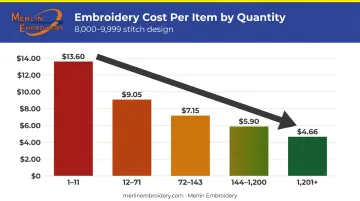
Setup and digitizing costs are spread across the total order. The per-item cost drops as quantity grows:
| Quantity | Cost per Item (8,000–9,999 stitches) |
|---|---|
| 1–11 pieces | $13.60 |
| 12–71 pieces | $9.60 |
| 72–143 pieces | $8.10 |
| 144–1,200 pieces | $7.10 |
| 1,201+ pieces | $4.66 |
Source: PrintCo published pricing
Some providers structure this as percentage discounts: Zeus' Closet publishes 10% off at 5–19 pieces, 20% at 50–99, and 30% at 200+.
Turnaround Time
Standard production typically runs 10–12 business days, though some providers quote a 2–3 week window including shipping. Rush orders carry a premium — Sport Stitch applies a flat 20% surcharge for orders requested before the standard lead time. Thread Logic's rush schedule runs from $85 for 8-day turnaround up to $250 for 4-day turnaround depending on order size.
Work backward from your event or distribution date. If you need finished garments in hand by a specific day, factor in shipping time on top of production — that 10-day window can shrink fast.
Full Cost Breakdown: What You're Actually Paying For
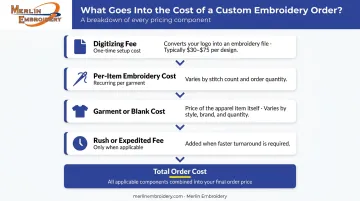
The total cost of a custom embroidery order goes beyond the per-item stitching fee. Budget for each of these components:
- Digitizing fee (one-time): Your artwork is converted into a machine-readable stitch file before any stitching begins. Charged once per design — typically $30–$75 for standard logos, more for gradient or puff work. The file is stored and reused on every reorder at no additional charge, which makes repeat orders more cost-effective.
- Per-item embroidery cost (recurring): The core production charge, based on stitch count, thread colors, and garment type. This is the number that drops with bulk orders and rises with design complexity.
- Garment or blank cost: When the shop supplies the apparel, blank garment pricing is added to the quote. Some shops accept customer-supplied items — Merlin Embroidery has worked with customers who brought their own scrubs and personal pieces for customization. Shops with direct brand relationships (Port Authority, Nike, Adidas, Columbia, Hanes, Gildan) typically offer better blank pricing than retail.
- Rush or expedited fees: Only apply when a standard lead time can't be met. Factor these in during deadline planning — not after you've already committed to a date.
Budget vs. Premium Embroidery — What's the Real Difference?
Not all embroidery quotes are equal. A lower price sometimes reflects shortcuts in digitizing quality, thread grade, or machine calibration that aren't visible immediately, but show up after a few wash cycles.
Three dimensions where quality differences appear:
Poor digitizing shows up in the wash. Puckering, thread breaks, and color distortion all trace back to rushed setup. Quality embroidery — done with proper digitizing and graded thread — holds its color, texture, and structure through 50+ warm-water wash cycles on cotton/poly shirts.
Consistency across large runs matters. High-speed computerized machines ensure every item in a batch looks identical. Less calibrated setups produce variation that becomes visible the moment 50 employees wear their shirts side by side.
Thread outlasts print. Unlike screen printing, thread doesn't crack, fade, or peel. Custom Ink's comparison guide notes embroidery runs $6–$8 more per location than printing — but thread lasts the garment's entire lifetime.
For businesses outfitting customer-facing staff or corporate teams, the math consistently favors the higher per-item cost. Replacing a uniform program 18 months early costs far more than paying an extra dollar per piece upfront.
How to Estimate the Right Budget for Your Embroidery Order
Accurate budgeting means accounting for all cost components — not just multiplying a per-item price by quantity.
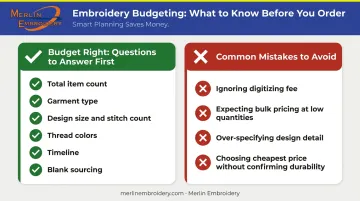
Answer these questions before requesting a quote:
- How many items total?
- What garment type (flat, curved, outerwear)?
- What design size and approximate stitch count?
- How many thread colors?
- Standard timeline or rush?
- Will you supply blanks or source through the provider?
Common budgeting mistakes to avoid:
- Ignoring the digitizing fee on a first order — budget for it separately
- Assuming bulk pricing kicks in at low quantities; most meaningful breaks start at 25–50 pieces
- Over-specifying design detail (gradients, tiny text under 0.25", 10+ colors) that increases stitch count without improving on-garment appearance
- Choosing the cheapest per-item price without confirming stitch durability, or whether the provider retains your file for future reorders
Once you've answered these questions, getting an accurate quote is straightforward. San Diego-area buyers working with Merlin Embroidery can expect pricing that runs 20–25% below typical market rates, with a 5–10 day turnaround compared to the industry-standard 2–3 weeks. Their team — with over 30 years serving local businesses, schools, and healthcare organizations — will walk through the full cost breakdown with you before any order is placed.
Conclusion
Custom embroidery pricing in 2026 varies significantly based on stitch count, design complexity, garment type, and order size — but with the right information, it's entirely predictable. A basic left-chest logo on standard apparel at moderate quantities runs $6–$10 per item in decoration cost. Complex, high-stitch designs on specialty garments push into $45–$65+ territory. Factor in a one-time digitizing fee, the garment blank, and any rush premium, and you have your real total.
Durability matters as much as price. Embroidery that holds up across 50+ wash cycles and represents your brand consistently is worth paying for — and it doesn't have to cost more than you expect. Shops like Merlin Embroidery, which runs 20–25% below typical competitor rates with 5–10 day turnarounds, show that quality and affordability aren't mutually exclusive. Request a detailed quote with all cost components itemized, and there won't be any surprises.
Frequently Asked Questions
What is the average cost of custom embroidery for apparel in 2026?
Decoration-only costs typically run $6–$14 per item for standard apparel like hats, polos, and t-shirts at small-to-mid quantities. Stitch count and order size are the two main variables — a 5,000-stitch logo at 50 pieces costs considerably less per item than a 15,000-stitch design at 10 pieces.
What is a digitizing fee and do I have to pay it every time I reorder?
Digitizing is a one-time fee, typically $30–$75, to convert your artwork into a machine-readable stitch file. Most providers save this file permanently, so future reorders of the same design skip the fee entirely.
How does order quantity affect the price per item for embroidery?
Setup and digitizing costs are spread across the full order, so per-item cost drops as quantity increases. Most providers begin offering meaningful discounts at 25–50 pieces, with the largest breaks typically appearing at 100+ units.
Is custom embroidery more expensive than screen printing?
Yes, embroidery typically costs $6–$8 more per location than screen printing. Thread doesn't crack, fade, or peel, so embroidery holds up better over time for staff uniforms and branded outerwear that see frequent washing.
What is the minimum order quantity for custom embroidery?
Minimums vary by provider — some accept single items, while others require 12 or 24 pieces. Merlin Embroidery, for example, handles orders starting at 12 pieces and scales up to 12,000, making it a practical option for both small runs and large programs.
How can I reduce the cost of my custom embroidery order?
- Simplify the design to reduce stitch count
- Limit thread colors to what's included in the base price
- Avoid tiny text and fine gradients that add stitches without improving the on-garment result
- Order in larger quantities to hit volume pricing thresholds
- Plan ahead to avoid rush surcharges
- Reuse your existing digitized file for every reorder