But here's where most buyers run into trouble: screen printing prices vary widely based on order size, design complexity, number of print locations, and garment quality. What looks like a straightforward per-shirt price often doesn't include setup fees, premium blanks, or rush charges — and that gap between the quoted price and the final invoice catches a lot of people off guard.
This guide breaks down typical price ranges, the variables that move costs up or down, and how to build an accurate budget before you place an order.
Key Takeaways
- Screen printing typically runs $5–$25 per shirt, depending on quantity and specs
- Order size is the single biggest cost lever — more shirts means lower per-unit cost
- Each ink color and each print location adds separate setup and run charges
- Premium blanks (Nike, Adidas) can cost 2–3x more than standard Gildan or Hanes
- Get an all-in quote — setup fees, garment cost, and add-ons should all be itemized upfront
How Much Does Local Screen Printing Cost Per T-Shirt?
There's no fixed per-shirt price in screen printing. Costs shift based on how many shirts you're ordering, how many colors are in your design, and what blank you choose. Misunderstanding this leads to underbudgeting or paying unnecessary setup fees on small runs.
Typical Cost Ranges by Order Size
According to French Press Custom's 2026 pricing guide, regional benchmarks for a standard blank with a 1-color, 1-location print (setup included) fall roughly in these ranges:
| Order Size | Typical Per-Shirt Range |
|---|---|
| Small run (12–24 shirts) | $15–$25 |
| Mid-range (25–72 shirts) | $8–$15 |
| Large order (72–288 shirts) | $5–$12 |
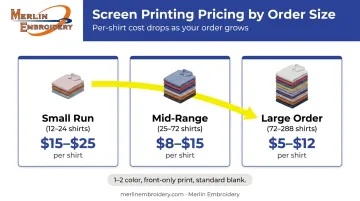
These ranges assume a basic 1–2 color design, front-only print, and a standard blank garment. They typically exclude additional print locations, premium garments, specialty inks, and rush fees.
Small Run (12–24 Shirts)
What's typically included: Standard blank (Gildan or similar), 1–2 color front-only print, basic screen setup.
Best for: Team events, small business promos, testing a design before scaling up to a larger order.
The per-shirt cost is highest at this tier because setup fees — charged per screen, per color — get spread across fewer garments. On a 12-shirt order, a $30 screen setup fee adds $2.50 per shirt before ink hits fabric.
Mid-Range Order (25–72 Shirts)
At this tier, setup costs spread across more shirts, making the per-unit price noticeably more manageable. Most shops also open up their garment catalog here, with options beyond basic blanks.
This range works well for:
- Company uniforms and restaurant staff apparel
- School clubs and sports teams
- Front-and-back prints (available at many shops starting at 25+ units)
Large Order (72+ Shirts)
What's typically included: Premium blank options, multi-color or multi-location prints become cost-effective, volume discounts apply across the run.
Best for: Corporate events, large organizations, multi-department rollouts, seasonal staff apparel.
At high volumes, the per-shirt print charge drops substantially. Branded Reno's published print-only pricing shows a 1-color charge falling from $5.10 at 12–23 units to $1.74 at 96–143 units — a 66% reduction in print cost alone, before garment pricing is factored in.
Key Factors That Affect the Cost of Local Screen Printing
Pricing at a local screen printer depends on a combination of production, design, and garment variables. Understanding each one lets you configure your order to hit the right price point.
Order Quantity
Screen printing setup costs are largely fixed regardless of how many shirts you print. The more shirts in a run, the more those fixed costs are diluted across the order. This is why the per-shirt price drops so sharply between a 12-piece and a 100-piece run — the ink and press time per shirt decreases, but so does the setup cost allocated per unit.
If you're near a pricing tier threshold, ordering slightly more shirts than you need right now often costs less overall than a small reorder later (which triggers new setup fees).
Number of Ink Colors
Each color in your design requires a separate screen — meaning separate setup fees and additional press passes. Here's how it breaks down:
- 1-color design: One screen, one press pass, lowest setup cost
- 4-color design: Four screens, four passes, proportionally higher setup and production time
- Photorealistic or gradient artwork: Requires simulated process printing, which adds complexity and cost beyond standard spot-color work
Number of Print Locations
Front-only prints are the cheapest configuration. Each additional location — back print, sleeve print, chest + back combination — is treated as a separate print job with its own screen setup and run charge.
Adding a back print to a front-only order can roughly double your setup and printing costs. Before adding locations for aesthetic reasons, check whether the price jump aligns with your budget — many shops will show you a side-by-side quote on request.
Garment Quality and Brand
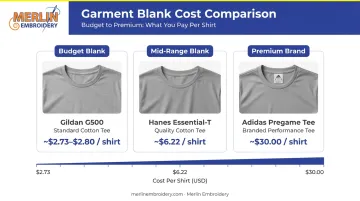
The blank garment itself is a major cost variable. Published wholesale pricing shows the range clearly:
- Gildan G500 Heavy Cotton: ~$2.73–$2.80 per shirt
- Hanes Essential-T: ~$6.22 per shirt
- Adidas Pregame Tee: ~$30.00 per shirt
That's a tenfold gap before printing costs are added. For large orders with premium branded garments like Nike, Adidas, or Port Authority, the blank cost can easily dominate the per-shirt total.
Design Complexity and Setup Fees
Screen setup fees — sometimes called screen fees or film fees — are charged per color, per design. Most regional printers charge $20–$35 per screen, though rates vary by shop.
Art preparation fees apply separately if your artwork isn't production-ready. Most shops charge $50–$75/hour for custom artwork development and a flat fee (often $20–$30) for simple text edits. If you're reordering the same design, most shops waive setup fees — ask your printer about their artwork reuse policy upfront.
Full Cost Breakdown: What You're Actually Paying For
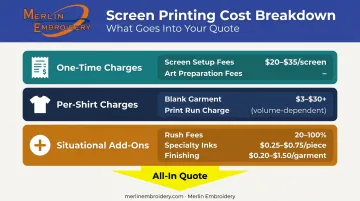
The per-shirt price is only part of what you'll pay. Screen printing orders include several distinct charge types — knowing each one upfront helps you catch hidden costs before they hit your invoice.
One-Time Charges (Per Order)
- Screen setup fees: Charged per color, per design — typically $20–$35 per screen. Usually waived on reorders of the same artwork. Ask your printer specifically about their reuse policy.
- Art preparation fees: Apply when artwork requires conversion or cleanup before it's production-ready. Bring a vector file (.AI or .EPS) or high-resolution print file to avoid or minimize these charges.
Per-Shirt Charges (Recurring Per Order)
- Blank garment cost: Varies by brand and style — from ~$3 for standard blanks to $30+ for premium performance tees
- Print run charge: Varies by quantity, number of colors, and number of locations — this is where volume discounts apply most directly
Situational Add-Ons
These charges are periodic and depend on your specific order:
- Rush fees: Published examples range from 20% for 3-day turnaround to 50–100% for same-day or next-day service
- Specialty inks: Metallic, puff, and discharge inks typically add $0.25–$0.75 per piece per location
- Finishing services: Individual folding, poly-bagging, and sticker application add $0.20–$1.50 per garment depending on the shop
For San Diego-area orders, Merlin Embroidery in La Mesa handles both screen printing and embroidery with a 5–10 day standard turnaround — roughly half the 2–3 week timeline many regional shops quote. Same-day service is available on select orders; ask when requesting a quote.
How to Estimate the Right Budget for Your Order
Getting your budget right means matching your order to your actual use case, timeline, and quality needs — not just hunting for the lowest number.
Before you request a quote, think through these four variables:
Intended use and wear frequency — Daily uniforms need more durable (and typically more expensive) garments than one-time event shirts. A $6 shirt that fades after 10 washes costs more per wear than a $15 shirt that holds up for two years.
Timeline and urgency — Standard turnaround at most local shops runs 5–10 business days from proof approval. Rush production exists but adds 20–100% to your total cost. Build your timeline around the standard window when possible.
Design reorder potential — If you'll reorder the same design, setup fees become a one-time investment. If your design changes each run, factor setup costs into every order's budget.
Volume flexibility — Ask your printer about tier pricing thresholds before finalizing quantity. Ordering 72 shirts instead of 60 might cost less per shirt and save you money overall — even if you end up with extras.
Once you've worked through these variables, you'll have a clearer picture of what to ask local printers. San Diego-area businesses can contact Merlin Embroidery (La Mesa) for quotes on screen printing and embroidery — they work with standard blanks and premium brands like Nike, Adidas, and Port Authority, with turnaround times of 5–10 business days and pricing typically 20–25% below competitors. Reach them at +1 619-884-9712 or merlinemb@gmail.com.
What Most People Get Wrong About Screen Printing Costs
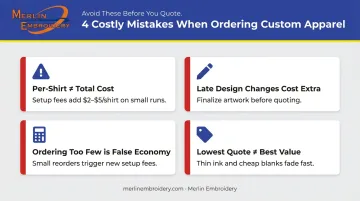
These are the four mistakes that consistently lead to budget surprises:
Per-shirt price isn't your total cost. On a 12-shirt order, screen setup fees alone can add $2–$5 per shirt. Get an all-in quote that covers setup, garment, and printing before comparing vendors.
Design changes after quoting cost more than most people expect. Adding ink colors, swapping garment styles, or requesting artwork revisions can trigger fees not in your original estimate — so finalize your design first.
Ordering too few shirts is a false economy. If 36 units hits the next price tier but you order 24, you pay more per shirt now and face setup fees again on the reorder. Do the math on your total quantity before confirming.
The lowest quote doesn't always reflect the best value. Unusually cheap pricing can signal lighter garment blanks or thin ink coverage that fades within a few washes. Request wash durability specs and a sample before placing a large order.
Conclusion
Screen printing costs vary based on order size, design complexity, ink colors, print locations, and garment quality — and understanding those variables before you request a quote is what separates accurate budgeting from cost overruns.
The right cost is the one that balances print quality, garment durability, turnaround time, and volume for your specific situation. If you're in the San Diego area, Merlin Embroidery has been helping businesses, schools, and teams navigate exactly these decisions for over 30 years — with upfront pricing, 5–10 day turnaround, and no guesswork on what you'll pay.
Frequently Asked Questions
How much does screen printing cost per shirt at a local shop?
Per-shirt prices typically range from $15–$25 for small runs of 12–24 shirts, dropping to $5–$12 for orders of 72 or more. These ranges assume a standard blank and 1–2 color front print. Always request an all-in quote that includes setup fees and garment costs — the per-shirt price alone rarely reflects your actual total.
What is the minimum order for local screen printing?
Most local screen printers set a minimum of 12–24 shirts due to the fixed cost of screen setup. Some shops will accommodate smaller orders, but expect a higher per-shirt rate to offset those setup costs across fewer garments.
Is local screen printing cheaper than ordering online?
It can be, especially when you factor in shipping costs and turnaround time. Local shops also allow in-person review of samples and proof approval — something online services can't offer. For rush orders in particular, a local shop's 5–10 day production window often beats online turnaround once shipping is included.
How long does screen printing take at a local shop?
Most local shops run a standard turnaround of 5–10 business days from proof approval. Same-day or expedited options may be available for an additional fee, typically ranging from 20–50% above the base price. Confirm lead times before placing your order.
What is the difference between screen printing and embroidery for business apparel?
Screen printing uses ink on fabric — ideal for large graphic areas and high-volume runs at a lower per-unit cost. Embroidery uses stitched thread, which holds up better over time and suits logos on polos, hats, and structured workwear. Merlin Embroidery in La Mesa offers both, helping you choose based on garment type and use case.
What should I bring or prepare before contacting a local screen printer?
Bring a vector or high-resolution artwork file (AI, EPS, or print-quality PDF), your approximate quantity, garment preference, ink colors, print locations, and deadline. A specific brief gets you a faster, more accurate quote.