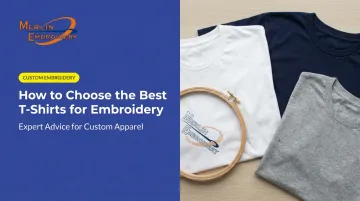
This guide covers exactly what to look for — fabric composition, weight, surface texture, blank brand quality, and how to match your shirt choice to your specific use case — so your embroidered apparel actually performs the way you need it to.
Key Takeaways
- 100% cotton and cotton-polyester blends are the most reliable fabrics for embroidery — stable, tightly woven, and able to hold stitch tension cleanly
- Fabric weight matters: heavier shirts (around 180–200 GSM) accommodate more demanding logos with fewer stabilizer issues
- Surface texture determines detail: smooth jersey and pique fabrics preserve fine lines and small text better than ribbed or slub weaves
- Blank brand quality drives consistency in bulk runs — stick with reliable names like Gildan, Port Authority, or Hanes
- Match shirt style and color to your use case: corporate uniforms, event shirts, and sports apparel each have different requirements
Why Your T-Shirt Choice Directly Impacts Embroidery Quality
Embroidery stitches anchor into the fabric's weave — they don't sit on top like a print. If the base fabric is too thin, too stretchy, or too loosely woven, the needle punches through inconsistently and the thread has nothing stable to grip.
Impressions Magazine classifies T-shirts as delicate, lightweight knits and warns that heavy fill stitching can overpower them — recommending lighter, more open designs and noting that running stitches bind the garment far less than dense satin stitching. Stretching during hooping is also flagged as a direct cause of post-release puckering.
Fabric Composition
The fabric you choose sets the ceiling for what's achievable. Here's how common T-shirt materials perform under the needle:
- 100% cotton (ring-spun or combed): Smooth stitching surface, good color absorption, and dimensionally stable under hoop tension. Pre-shrunk versions eliminate the main downside — post-wash shrinkage.
- Cotton-polyester blends: A 2023 peer-reviewed laundering study found that the polyester component contributes measurably to wash resistance and dimensional stability, making blends a reliable choice for uniforms that go through frequent commercial laundering.
- Pure polyester and tri-blends: Introduce stretch that can shift stitches during production. Popular in retail fashion, but they require careful stabilizer selection and simpler designs to get clean results.
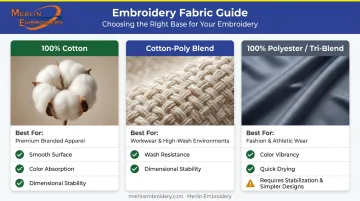
Fabric type also determines how shrinkage will affect your finished design — which is worth thinking through before a single stitch is placed.
The Shrinkage Problem
If a shirt hasn't been pre-shrunk or dimensionally treated before embroidery, post-wash shrinkage can pucker and warp the design. CottonWorks documents that laundering-induced dimensional change is a direct cause of garment seam puckering, and that finishing processes like compacting and relaxation drying improve stability. Always look for pre-shrunk blanks or confirm your supplier pre-treats garments before stitching.
Key Factors When Choosing T-Shirts for Embroidery
Get these decisions right and your embroidery will look sharp through 50+ washes. Get them wrong and you're reprinting, re-hooping, or eating defect costs. Each factor below has a direct impact on stitch quality, durability, and production efficiency.
Fabric Type: Cotton vs. Cotton-Polyester Blends
| Fabric | Best For | Watch Out For |
|---|---|---|
| 100% cotton (ring-spun/combed) | Premium branded apparel, clean stitch surface | Verify pre-shrunk treatment |
| Cotton-poly blend (60/40 or 50/50) | Workwear, high-wash environments (healthcare, food service) | No single blend ratio universally outperforms others — test first |
| 100% polyester performance knit | Industrial laundry environments | Higher stretch requires more aggressive stabilization |
For most corporate and branded apparel, a quality 100% cotton or 60/40 cotton-poly blank covers the majority of use cases.
Fabric Weight (GSM)
GSM — grams per square meter — measures fabric mass per unit area. Higher GSM generally means a denser, heavier shirt that can accommodate more demanding logos with fewer production complications.
Practical benchmarks from official brand specifications:
- Gildan Ultra Cotton 2000: officially listed at 203 g/m² — a heavyweight option well-suited to embroidery
- Hanes Beefy-T (O5180): specified at 6 oz/yd² ring-spun cotton with double-needle construction
- Port & Co Core Cotton PC54: 5.4 oz/yd² — a midweight blank that works for less dense logos
Heavier shirts mean fewer stabilizer adjustments, fewer re-hooping issues, and lower defect rates on bulk orders. Lightweight fashion tees (under ~140 GSM) introduce more variables and require heavier backing to compensate.
Surface Texture and Weave
Smooth jersey and pique fabrics let fine stitch detail remain visible. Heavily textured fabrics introduce problems worth knowing upfront:
- Ribbed knit: thread sinks into channels, blurring fine lines
- Slub cotton: irregular yarn thickness disrupts stitch registration
- Waffle-knit: deep surface structure obscures small text almost entirely
Pique polo shirts deserve a specific mention here. Their structured surface grips thread without stretching under stitch tension, which is why pique dominates in corporate and hospitality uniform programs. Still, pique's visible texture means fine design elements can sink slightly — always run a sample sew-out before placing a bulk order on textured fabric.
Blank Brand and Construction Quality
Once you've chosen fabric type and weight, brand consistency becomes the next variable. Two shirts labeled "100% cotton heavyweight" can behave differently on the machine — because needle count, colorfastness, seam reinforcement, and collar construction vary significantly between manufacturers.
Brands like Gildan, Port Authority, and Hanes are widely used by professional embroidery shops because they deliver predictable, consistent results across bulk orders. The Gildan Ultra Cotton line, for example, was re-engineered in 2024 with updated yarn and finishing — specifically positioning it for decorators.
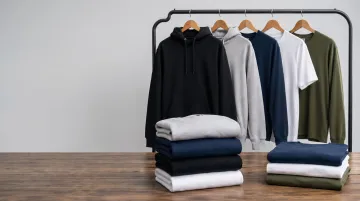
The risk of unknown blanks:
- Inconsistent sizing across a bulk run
- Color variation between production batches
- Fabric irregularities that cause stitch registration errors — any of which can push a large order past deadline and into rework territory.
Best T-Shirt Styles and Colors for Embroidery
T-Shirts vs. Polo Shirts
| Style | Best For | Key Consideration |
|---|---|---|
| Jersey crew neck tee | Events, sports teams, schools, casual brand apparel | Choose medium-to-heavy weight; keep designs relatively simple |
| Pique polo | Corporate uniforms, hospitality staff, trade shows | Structured surface handles left-chest logos well |
| Performance polo | Industrial laundry environments (healthcare, food service) | Confirm care compatibility with your wash process |
The right style depends on the setting and the image your organization wants to project. Once you've matched the garment to the occasion, color contrast becomes your next decision.
Color Contrast
Color contrast is a functional decision, not just an aesthetic one:
- Dark shirts (navy, black, charcoal): pair with lighter or metallic threads — white, gold, cream — for high-visibility logos
- Light shirts (white, light gray): work best with darker, saturated thread colors
- Mid-tone shirts (charcoal, navy, olive): offer the most versatile thread color pairings for multi-color logos
An ASI trade resource advises choosing contrasting thread when the stitching needs to stand out — brand colors and accessibility contrast should guide the final decision.
Design Complexity
Embroidery rewards simplicity. Bold shapes with clean outlines stitch precisely and hold up wash after wash. These design elements tend to work well:
- Large block lettering or bold wordmarks
- Simple icon shapes with defined edges
- Two- to four-color logos without gradients
Very small text, thin outlines, and photographic detail don't translate reliably into thread — screen printing handles those better. If your logo has significant fine detail, talk through simplification options with your embroidery provider before finalizing your approach.
Matching Your T-Shirt Choice to Your Use Case
| Use Case | Recommended Shirt | Key Reason |
|---|---|---|
| Corporate offices / customer-facing staff | Pique polo, neutral colors (navy, black, white) | Structured surface, professional appearance |
| Healthcare | Cotton-poly performance polo, care-compatible | High-frequency washing at 60°C requires dimensional stability |
| Food service / hospitality | Industrial-laundry-rated performance polo | Soil release, color retention, wash durability |
| Construction / field services | Heavyweight cotton or cotton-poly workwear polo | Movement, snag resistance, visible identification |
| Sports teams / athletic | Cotton-poly blend jersey tee | Comfort, durability, moisture management |
| Events / schools | Standard cotton jersey tee, brand colors | Cost-effective for lower wash frequency |
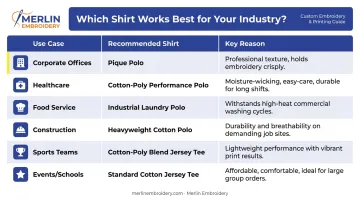
The table covers the basics, but two factors often get overlooked until it's too late:
Wash frequency: High-frequency commercial laundering demands cotton-poly blends that resist shrinkage and color fading. Occasional-wear event shirts can tolerate 100% cotton for its premium hand feel.
Logo complexity: A highly detailed logo may need to be simplified or resized for left-chest placement. Confirm this with your embroidery provider before ordering blank shirts — catching it early avoids costly do-overs.
How Merlin Embroidery Helps You Choose the Right Shirt
For buyers in San Diego, La Mesa, and the greater LA area, Merlin Embroidery matches the right garment to your logo, use case, and budget before production begins. With over 30 years of experience serving corporate offices, sports teams, schools, healthcare facilities, and restaurants, the team maintains direct relationships with leading apparel brands — Port Authority, Gildan, Hanes, Nike, Adidas, and Columbia among them.
That means clients don't need to research blanks on their own — the team matches the right garment to the logo, use case, and budget before production begins.
What Merlin Embroidery brings to the table:
- Access to a vetted catalog of blanks across weight, composition, and style from top brands
- Direct client guidance from team members like Kevin McClenahan, who aligns garment selection with your design requirements
- Computerized embroidery machines delivering consistent, precise stitching from small batches to bulk runs
- Turnaround in 5–10 days (versus the industry standard of 2–3 weeks), with same-day options for urgent orders
- 50+ wash durability built into every order through garment selection and production standards
- 4.9/5 rating across 135+ customer reviews
If you're planning an embroidered apparel order and aren't sure where to start on shirt selection, reach out to the Merlin Embroidery team directly. A quick conversation — phone at +1 619-884-9712 or email at merlinemb@gmail.com — covers garment options, logo sizing, and production timeline before any work begins.
Frequently Asked Questions
What shirt material is best for embroidery?
100% cotton and cotton-polyester blends are the top choices — both are stable, tightly woven, and hold stitch tension without puckering. Fabric weight matters just as much as composition: heavier shirts in the 180–200 GSM range handle most logos more reliably than lightweight fashion tees.
Can you do embroidery on t-shirts?
Yes, t-shirts work well for embroidery when they use the right fabric. Smooth jersey cotton or cotton-blend tees at medium-to-heavy weight produce clean results. Lightweight or highly stretchy tees require extra stabilization and often don't deliver the crisp finish that heavier blanks do.
Are Gildan shirts good for embroidery?
Gildan's Ultra Cotton line (officially specified at 203 g/m²) is one of the most widely used blanks in professional embroidery shops. Its consistent weight, smooth surface, and double-needle construction make it a reliable, affordable choice for bulk branded orders.
What fabric weight is recommended for embroidered t-shirts?
The 180–200 GSM range is a commonly used benchmark for standard embroidery work. Shirts below roughly 140–150 GSM tend to require heavier stabilizers and simpler designs to avoid puckering. For context, the Gildan Ultra Cotton and Hanes Beefy-T both fall at or above 200 GSM.
What is the best placement for embroidery on a t-shirt?
Left-chest placement is the most common choice for logos, typically 3–4 inches wide. Center chest suits larger graphic designs, while sleeve and back placements work for specific branding styles. The best option depends on your design size and the garment's intended use.
Should I choose a t-shirt or a polo for embroidery?
Polos, especially pique fabric, suit corporate, hospitality, and customer-facing environments because of their structured look and superior stitch surface. T-shirts work better for events, sports teams, and casual brand apparel.