That said, the total cost per embroidered work shirt varies widely. Shirt type, logo complexity, order quantity, and provider all pull the final number in different directions. Miss one variable and your budget estimate can be off by 30% or more. This guide breaks down every pricing component so you can plan accurately before placing an order.
TL;DR
- Typical all-in cost: $20–$31 per shirt for standard orders (garment + left-chest embroidery), with bulk orders dropping below $20 per unit
- Two biggest price drivers: stitch count (logo complexity) and order quantity
- Small runs, intricate logos, premium garment brands, and rush timelines all push costs higher
- Ordering 48+ shirts with a clean logo on a mid-tier garment is the fastest path to a lower per-unit price
- A bargain quote on a fragile garment usually costs more long-term than a slightly higher price on a durable one
How Much Do Embroidered Work Shirts Cost in 2026?
Embroidered work shirts don't have a single fixed price. The final cost per unit depends on the base shirt, embroidery complexity, and quantity ordered — and misunderstanding any one of these can create budget surprises.
Two mistakes come up constantly: underestimating how much stitch count affects cost on complex logos, and forgetting to factor the one-time digitizing fee into the total order budget.
Here's how pricing typically breaks down by order size.
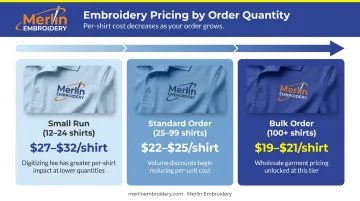
Entry-Level / Small Run (12–24 Shirts)
Estimated all-in range: $27–$32 per shirt
This tier covers the garment plus a standard left-chest embroidery. Published benchmarks from 4imprint's Port Authority polo pages show prices of $27.25–$31.25 at the 12–24 unit range.
At this scale, the digitizing fee has the most noticeable impact — spread across 12–24 units, a $57 setup fee adds roughly $2.40–$4.79 per shirt to your true cost.
Good fit for:
- New businesses testing branded apparel before a larger commitment
- Seasonal or temporary staff needing a small uniform run
- Trial orders to confirm fit, color, and logo placement
Mid-Range / Standard Order (25–99 Shirts)
Estimated all-in range: $22–$25 per shirt
Volume discounts kick in here. The per-unit embroidery rate drops, and garment costs often decrease through established supplier relationships. The 24-to-48 unit step typically delivers the single largest price reduction: approximately $3.70–$3.75 per shirt saved based on published pricing data.
Best suited for growing teams, restaurant staff, department rollouts, or any order where consolidating multiple locations into one purchase makes sense.
Bulk / Enterprise Order (100+ Shirts)
Estimated all-in range: $19–$21 per shirt
Per-unit costs drop sharply here, and businesses gain access to wholesale apparel pricing that can meaningfully cut the garment cost per unit. Published data shows the 12-to-144 unit price drop reaches 34–36% across comparable Port Authority polos.
This tier makes sense for large companies, multi-location businesses, healthcare facilities, and annual uniform programs.
What's Typically Included vs. Excluded
| Included in Base Quote | Usually Billed Separately |
|---|---|
| Base garment cost | Rush production fees |
| Left-chest embroidery | Additional placement locations |
| Standard thread colors (up to ~9) | Oversized back designs |
| Digitizing (sometimes bundled) | Specialty techniques (3D puff, etc.) |
Key Factors That Affect the Cost of Embroidered Work Shirts
The final price is shaped by several technical and logistical variables. Understanding each one helps businesses build accurate budgets and avoid surprise charges.
Shirt Type and Base Garment Cost
The base shirt is often the largest single cost component. Consider the spread:
- Budget tier (Hanes, Gildan polos): wholesale starting around $14.60–$14.66
- Mid-tier (Port Authority Silk Touch): starting around $20.08
- Premium tier (Nike Dri-FIT, Columbia): $50–$62+ before a single stitch
That range means garment choice can outweigh embroidery cost entirely on premium brands.
Fabric also affects embroidery quality. Structured fabrics like piqué polo knit and twill hold stitches more cleanly than lightweight jersey blends. Per embroidery equipment guidance from Melco, stretchy or unstable fabrics require cutaway stabilizer to prevent distortion — which is worth factoring into production time and setup.
Logo Complexity and Stitch Count
Most embroidery providers price by stitch count — the more stitches, the longer the machine runs, and the higher the cost per unit.
Here's a directional reference based on industry billing tiers:
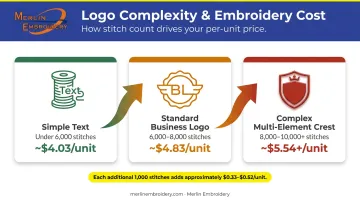
| Logo Type | Approximate Stitch Count | Per-Unit Embroidery Cost (24–59 units) |
|---|---|---|
| Simple text only | Under 6,000 | ~$4.03 |
| Standard business logo | 6,000–8,000 | ~$4.83 |
| Complex multi-element crest | 8,000–10,000+ | ~$5.54+ |
Source: US Colorworks embroidery pricing table. Garment cost is excluded from these figures.
Each additional 1,000 stitches beyond 10,000 adds roughly $0.33–$0.52 per unit depending on quantity. A detailed corporate crest can push stitch counts to 12,000–15,000+, which adds up fast on large orders.
Digitizing Fee
Every new logo must be digitized — converted from a flat image (JPEG, PNG, or vector file) into a machine-readable stitch file — before production begins. This is a one-time charge, not a recurring cost.
Fee ranges vary by provider:
- US Colorworks: $8 per 1,000 stitches, $40 minimum
- QRSTS: $57.50 per position up to 4×4 inches, $99 for larger placements
Once digitized, the same stitch file is reused for every future order with no additional digitizing charge. Spread across 100 shirts, a $57.50 digitizing fee works out to just $0.58 per unit — a negligible cost at scale.
Order Quantity
Volume is the single most effective lever for reducing per-unit cost. A Port Authority performance polo, for example, drops from $30.50 per shirt at 12 units to $19.50 at 144 units — a 36% reduction.
The steepest savings happen early:
| Quantity Range | Typical Per-Shirt Savings |
|---|---|
| 12 → 24 units | ~$3.00–$3.50 |
| 24 → 48 units | ~$3.70–$3.75 |
| 48 → 144 units | ~$4.00–$7.00 cumulative |
If you're close to a quantity tier, ordering a few extra shirts often pays for itself.
Number of Logo Locations
Each placement location — left chest, right chest, sleeve, back — is treated as a separate embroidery job with its own stitch count and per-unit charge. A shirt with a chest logo plus a back design could add $5–$10 per unit over a single-placement order at standard stitch counts. If budget is tight, prioritizing the left chest placement alone delivers the most brand visibility per dollar spent.
The Complete Cost Breakdown for an Embroidered Work Shirt Order
Here's how a full order cost typically breaks down:
1. Base Garment Cost The blank shirt — which varies by brand, style, and fabric. On premium garments, this component can represent a significant share of your total per-shirt cost. Budget-tier shirts keep this low; Nike or Columbia shirts can push it past $50 before decoration.
2. Digitizing Fee The upfront cost to create the stitch file. Spread across a large order, the per-unit impact is minimal. On a 12-shirt order, it can add $4–$5 per shirt; at 100 shirts, under $1.
3. Embroidery Service Cost The per-shirt charge for running the design on the machine, priced by stitch count and quantity tier. This is where volume discounts have the most direct effect. San Diego-based providers like Merlin Embroidery typically turn around orders in 5–10 days, compared to the 2–3 weeks many larger national vendors quote.
4. Optional Add-Ons
- Rush production fees (typically +20–100% depending on timeline)
- Additional placement locations (each billed separately)
- Specialty techniques like 3D puff embroidery
- Extra thread colors beyond the standard allowance
Don't assume these are included in a base quote. Always ask for an itemized breakdown.
Budget vs. Premium Embroidered Work Shirts — What's the Difference?
"Budget" and "cheap" aren't the same thing. The right tier depends on how and how often the shirt will be worn.
| Attribute | Budget Tier | Premium Tier |
|---|---|---|
| Base garment | Gildan, Hanes ($14–$16 wholesale) | Nike, Columbia ($50–$62+ wholesale) |
| Brand perception | Functional, professional | Corporate, elevated |
| Thread quality | Standard polyester | High-grade polyester, OEKO-TEX certified options |
| Logo definition | Good on structured fabrics | Excellent, especially on piqué and twill |
| Long-term cost per wear | Higher (shirt wears out faster) | Lower (shirt lasts significantly longer) |
Budget shirts make sense for:
- Short-term events, seasonal staff, or high-turnover roles
- Situations where shirts are replaced annually regardless of condition
Premium shirts pay off for:
- Customer-facing staff, corporate teams, and healthcare professionals
- Any role where the shirt represents the brand every single day
Note that embroidery digitization fees apply equally across both tiers — the garment cost is where the real price gap lives.
How to Estimate the Right Budget and Avoid Common Mistakes
Getting the budget right means thinking beyond the per-shirt price. These four principles help you avoid the most common ordering mistakes.
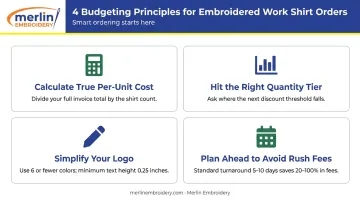
Anchor on total order cost, not per-unit price. Divide your full invoice — garments + digitizing + embroidery + add-ons — by the number of shirts. That's your true cost per unit, and the only valid number to compare across quotes.
Order enough to hit the right pricing tier. Ordering 46 shirts instead of 48 could mean missing a volume break that saves several dollars per unit across your whole order. Before finalizing quantities, ask your provider where the next discount threshold falls.
Simplify the logo for embroidery. Designs with gradients, very fine text, or 10+ colors drive stitch counts up sharply. Per Melco's official embroidery design guidelines, lowercase text should be at least 0.25 inches tall, uppercase at least 0.3 inches, and logos should use six or fewer colors. Cleaner designs can save $15–$30 per order on stitch count alone.
Plan ahead to avoid rush fees. Rushing an order adds 20–100% to costs depending on the timeline. Shops with faster standard turnarounds — 5–10 days versus the 14-day average — let you sidestep rush charges entirely without scrambling at the last minute.
Conclusion
The cost of embroidered work shirts depends on four things working together: the shirt you choose, how complex your logo is, how many units you order, and which provider you work with. Get all four right, and you'll end up with shirts that hold up, look sharp, and fit your budget.
The right order balances per-unit cost, durability, and brand presentation — and those variables look different for every business. For San Diego companies working through exactly that calculation, Merlin Embroidery has been a local resource for over 30 years. Where most providers take 2–3 weeks, Merlin delivers in 5–10 days — at pricing that runs 20–25% below market rates. Get a quote today to see what your order would cost.
Frequently Asked Questions
How much should an embroidered shirt cost?
Most standard orders — garment plus a left-chest logo — land between $20 and $32 per shirt, depending on quantity and logo complexity. Bulk orders of 100+ units can push that figure below $20, while small runs of 12 shirts sit at the higher end of the range.
What is a digitizing fee and is it charged every time?
Digitizing converts your logo into a machine-readable stitch file. It's a one-time fee, typically $40–$99 depending on design size and complexity. Once created, that file is reused for all future orders at no additional digitizing cost.
How does order quantity affect the price of embroidered work shirts?
Larger orders unlock volume pricing tiers for both embroidery and garment costs. Published data shows per-shirt prices dropping 34–36% from 12 to 144 units, with the largest single step occurring between 24 and 48 shirts.
How long does it take to get embroidered work shirts produced?
Standard industry turnaround runs 7–14 business days at most shops. Merlin Embroidery delivers in 5–10 days, and same-day service is available for urgent orders. Contact the team directly to confirm same-day availability before placing a rush order.
Is embroidery better than screen printing for work shirts?
For professional work shirts, embroidery produces a raised, durable finish that holds up through repeated commercial washing without fading or cracking. It's the standard choice for uniforms, corporate apparel, and any shirt representing a brand daily.
How many stitch colors can be included in an embroidered logo?
Most commercial machines accommodate 9–16 needle colors. Standard pricing includes up to 9 colors, with 10–15 colors adding a small surcharge. Keeping logos to 3–6 colors produces the cleanest result and avoids extra costs.