Introduction
The blank crewneck sweatshirt is one of the most printed garments in the custom apparel industry — ordered by schools, sports teams, small businesses, and corporate clients by the thousands every year. Many buyers choose their blank based on price alone, which leads to cracked prints, inconsistent sizing across a bulk run, or a sweatshirt that distorts after the first wash.
Not all blank crewnecks behave the same under production conditions. Fabric blend, stitch density, fleece face construction, and weight all determine how ink adheres and how cleanly detail transfers.
Get those factors wrong, and even a flawless design can look disappointing on the finished product.
This guide covers the five blank crewneck sweatshirts most trusted by professional screen printers: each with print-tested specs, practical use-case guidance, and key factors to evaluate before committing to a bulk order.
Key Takeaways
- Cotton-polyester blends (50/50 to 70/30) hold plastisol ink better than 100% polyester for standard screen printing
- High stitch density and a smooth fleece face matter more than fabric weight for print clarity
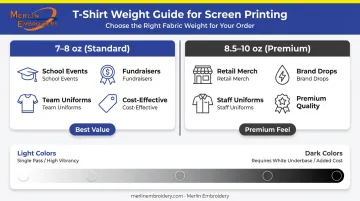
- Heavier blanks (8.5–10 oz) suit retail and premium merch; lighter options (7–8 oz) work for high-volume event orders
- Gildan and Jerzees lead for budget-volume work; Independent Trading Co. and Bella + Canvas suit premium applications
- Always order a sample and run wash tests before committing to any new blank at scale
What Makes a Blank Crewneck Good for Screen Printing?
Fabric Blend
Cotton-polyester blends are the standard for screen printing on fleece. Cotton absorbs plastisol ink, contributes color vibrancy, and reduces dye migration risk during the heat curing process. Polyester adds dimensional stability and cuts down on shrinkage.
According to Avient's dye migration technical bulletin, migration risk increases as polyester content rises, with issues possible above 265°F — well below the 320°F standard plastisol cure temperature. That's why 100% polyester blanks require specialized low-bleed inks or sublimation rather than standard screen printing.
The practical range for crewneck blanks: 50/50 to 70/30 cotton/polyester for most screen printing applications.
Stitch Density and Fleece Face
Stitch density is the most important structural factor most buyers overlook. A high stitch density creates a tighter, smoother surface that lets ink sit evenly without sinking into fabric loops. Jerzees' official product documentation describes more stitches per inch as producing "a smoother, more consistent printing canvas."
S&S Activewear notes the same principle for Gildan's Heavy Blend, citing finer face yarn as the key to reduced pilling and better print adhesion.
Look for these terms when evaluating a blank: pill-resistant fleece, high-density fleece, cotton-face construction, 3-end fleece.
Fabric Weight
Weight affects both print surface quality and perceived value:
- 7–8 oz: Cost-effective for high-volume orders like school events, fundraisers, and team uniforms
- 8.5–10 oz: Thicker fleece, flatter print surface, better for retail merch, brand drops, and staff uniforms where the garment itself reflects on the brand
Preshrinking and Color Choice
Always confirm a blank is preshrunk before ordering in bulk. Screen printing cures at high heat, and any further shrinkage after the first wash can affect how the print looks on the body.
Color selection follows a similar logic: lighter colors (white, ash, sport grey) deliver the most ink vibrancy with a single pass. Dark colors require a white underbase layer, which adds both cost and complexity — factor that into your project budget upfront.
Best Blank Crewneck Sweatshirts for Screen Printing
These five crewnecks are selected based on printability, fabric quality, color availability, and consistent performance across screen printing operations of all sizes.
Gildan Heavy Blend Crewneck Sweatshirt (18000)
The Gildan 18000 is the industry's most commonly used blank crewneck — and for good reason. At 8 oz with a 50/50 cotton/polyester blend, it hits the sweet spot between affordability and reliable print performance. Schools, event organizers, and fundraiser coordinators reach for it because it works, ships consistently, and keeps per-unit costs manageable on large runs.
S&S Activewear notes that the Heavy Blend uses finer face yarn that creates a smoother printing surface and reduces pilling — two features that matter directly to print quality. ASI has specifically highlighted the 18000 for campus giveaways and school clubs, which reflects where it genuinely excels.
| Spec | Detail |
|---|---|
| Fabric | 50/50 Cotton/Polyester, 8 oz |
| Best For | High-volume orders, school/event merch, budget-conscious projects |
| Standout Feature | Dense fleece face, consistent sizing across bulk runs |
Jerzees NuBlend Crewneck Sweatshirt (562MR)
The Jerzees 562MR is an 8 oz, preshrunk 50/50 cotton/polyester crewneck with NuBlend pill-resistant fleece, available in 41 colors (confirmed on Jerzees' official product page). It's a reliable pick for screen printers who need a clean printing canvas at a competitive price.
The NuBlend fleece's high stitch density creates one of the smoothest print surfaces in its tier. Jerzees' own documentation confirms that more stitches per inch produce a more consistent printing canvas — which translates directly to crisper line detail and reduced ink bleed on production runs. The relaxed, slightly boxy fit suits teams and organizations that prioritize comfort over a fashion-forward silhouette.
| Spec | Detail |
|---|---|
| Fabric | 50/50 Cotton/Polyester NuBlend, 8 oz |
| Best For | Bulk screen printing, team uniforms, relaxed-fit preference |
| Standout Feature | Pill-resistant, high-density fleece; 41 confirmed color options |
Independent Trading Co. Heavyweight Crew (IND3000)
The IND3000 sits at the premium end of this list. At 10 oz with a 70/30 cotton/polyester blend (per Independent Trading Co.'s current official product page; some sources cite 80/20, but that reflects older specs), this is the blank streetwear brands and retail merch lines reach for when the sweatshirt itself is part of the product.
The ring-spun cotton 3-end fleece construction creates what Independent's own page describes as "a smooth, stable fabric surface for printing." The heavier weight delivers a thick, flat canvas that holds bold graphics and fine detail with less risk of surface distortion. The modern cut runs slightly longer than Gildan or Jerzees, giving it a retail-ready silhouette.
| Spec | Detail |
|---|---|
| Fabric | 70/30 Cotton/Polyester, 10 oz (330 gsm) |
| Best For | Retail brands, premium merch drops, staff uniforms, streetwear |
| Standout Feature | Heavyweight ring-spun fleece; smooth, stable print surface |
Hanes EcoSmart Crewneck Sweatshirt (P160)
The Hanes P160 is a mid-budget crewneck built around PrintPro XP fleece — a low-pill, high-stitch-density construction that S&S Activewear describes as specifically engineered for printing. It's a solid option for organizations that need reliable print performance without stepping up to premium price points.
The P160 also incorporates recycled polyester content, which makes it a natural fit for eco-conscious brands and non-profits. For clients running sustainable initiatives or private label projects with green requirements, the EcoSmart line is a natural match.
Specifications reflect distributor documentation via S&S Activewear; exact recycled content percentage per Hanes' own spec sheet was not confirmed at time of writing.
| Spec | Detail |
|---|---|
| Fabric | 50/50 Cotton/Polyester (with recycled content), ~7.8 oz |
| Best For | Eco-conscious brands, organizations, private label projects |
| Standout Feature | PrintPro XP fleece engineered for printing; tearaway label |
Bella + Canvas Sponge Fleece Crewneck (3901)
The Bella + Canvas 3901 is built for brands where the sweatshirt is part of the product experience, not just a vehicle for a logo. The current official spec lists it at 8 oz with a 52/48 Airlume combed and ring-spun cotton/polyester sponge fleece — some older references cite 7 oz, but Bella + Canvas' 2026 catalog confirms 8 oz for solid and heather colorways.
The sponge fleece construction delivers an exceptionally soft hand-feel while maintaining a surface smooth enough for detailed screen prints. One practical note from Bella + Canvas' own printing guidance: sueded fleece versions are not suited for small graphics with fine detail or tight registration. For best print results, stick to the standard sponge fleece in solid or heather colorways.
| Spec | Detail |
|---|---|
| Fabric | 52/48 Airlume Cotton/Polyester Sponge Fleece, 8 oz |
| Best For | Lifestyle brands, retail merch, fashion-forward employee apparel |
| Standout Feature | Ultra-soft sponge fleece; modern unisex fit; premium retail aesthetic |
How to Choose the Right Blank for Your Project
Selecting a blank isn't just about brand preference — it's about matching the garment to the job.
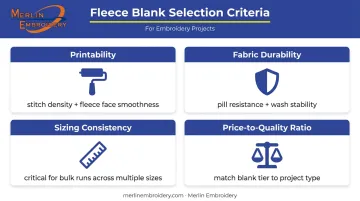
Four criteria that matter most:
- Printability — stitch density and fleece face smoothness determine how clean your ink lays down
- Fabric durability — pill resistance and wash stability affect how the print looks after repeated use
- Sizing consistency — critical for bulk orders running across multiple sizes
- Price-to-quality ratio — the right blank for a fundraiser isn't the right blank for a retail merch drop
A common mistake: choosing based on price without checking stitch density. A cheap blank with a loose fleece face will cost more in reprints and customer complaints than a slightly more expensive high-density option.
Before any large order, test first:
- Order one sample
- Run a test print with your standard ink and cure settings
- Wash it three to five times
- Assess color retention, surface integrity, and size stability
That testing process is where experience matters. Merlin Embroidery has run this protocol across orders from 12 to 12,000 garments over 30 years of production, working directly with Gildan and Hanes — two of the most consistent performers for high-volume screen printing.
Conclusion
The right blank depends on what you're making and who it's for:
- Gildan 18000 or Jerzees 562MR — best for budget-conscious volume work: school orders, fundraisers, event merch
- Independent Trading Co. IND3000 — best for retail-grade merch, streetwear, and premium staff uniforms
- Bella + Canvas 3901 — best for lifestyle and fashion-forward brand applications
- Hanes EcoSmart P160 — best for eco-conscious organizations and private label projects
That said, the blank is only half the equation. Print quality also depends on ink selection, cure temperature, and how well a printer understands fleece behavior under production conditions. Those factors differ considerably between a 7 oz sponge fleece and a 10 oz heavyweight ring-spun blank.
Businesses, schools, and organizations in San Diego, La Mesa, or Los Angeles can get custom crewneck orders screen printed through Merlin Embroidery — with a 5–10 day turnaround and pricing 20–25% below what most competitors charge. Contact the team at merlinemb@gmail.com or +1 619-884-9712 to get a quote.
Frequently Asked Questions
What is the best fabric to screen print on?
Cotton-polyester blends (50/50 to 70/30) are the most reliable for screen printing on sweatshirts. Cotton absorbs ink well and produces vibrant color; polyester adds dimensional stability and reduces shrinkage. Pure cotton works too, but expect more shrinkage unless the blank has been properly preshrunk.
Does sweatshirt weight affect screen printing quality?
Heavier blanks (8.5–10 oz) provide a thicker, flatter print surface that holds fine detail better and resists distortion during curing. Lighter options (7–8 oz) are more economical for high-volume orders where surface structure is less critical.
Can you screen print on 100% polyester crewnecks?
Standard plastisol is not ideal for 100% polyester. Curing temperatures around 320°F can trigger dye migration, causing print colors to bleed or shift. Polyester blanks work better with sublimation printing or low-bleed polyester ink systems designed for the purpose.
Do screen printed sweatshirts crack or fade after washing?
Print longevity depends on blank quality and process execution. Properly preshrunk, tightly woven blanks combined with fully cured plastisol ink hold up well through repeated washing. Wash test any new blank three to five times before committing to a bulk production run.
What is the minimum order quantity for screen printed crewnecks?
Most professional screen printers work with minimums in the range of 12–48 pieces per design to cover screen setup costs. Merlin Embroidery handles orders from as few as 12 pieces up to 12,000, whether you're ordering for a small team or a large organization.
Is the Gildan 18000 or Jerzees 562MR better for bulk orders?
Both are strong performers for high-volume work. The Gildan 18000 has a wider color range and broader distributor availability. The Jerzees 562MR's NuBlend fleece is explicitly engineered for print smoothness, making it the better pick for jobs where print detail is the priority.