The method you choose affects how much you spend per unit, how the apparel holds up after two years of weekly washing, and whether your team looks polished or promotional. A restaurant outfitting 80 servers has different needs than a startup ordering 15 custom tees for a trade show. Getting this decision wrong means either overpaying or ending up with prints that crack by month three.
This guide breaks down how each method works, where each one wins, and which factors should drive your choice — whether you're ordering branded polo shirts, event tees, or a mix of both.
Key Takeaways
- DTG is ideal for small runs (1–50 pieces) with complex, multi-color artwork — no setup costs, but works best on cotton
- Screen printing delivers the lowest cost per unit at volume (24+ pieces) with bold, simple designs
- Embroidery offers the highest durability and most professional finish — thread doesn't crack, fade, or peel
- Decision factors — design complexity, order volume, garment type, and intended use — determine the right method
- Mixed approaches work — many organizations use embroidered polos for staff and screen-printed tees for events
DTG vs. Screen Print vs. Embroidery: Quick Comparison
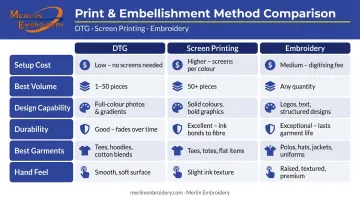
Here's a side-by-side reference across the factors that matter most for your purchasing decision.
| Factor | DTG | Screen Printing | Embroidery |
|---|---|---|---|
| Setup Cost | None | Per-screen fee per color | One-time digitizing fee |
| Best Volume | 1–50 pieces | 24+ pieces | Flexible; scales well |
| Design Capability | Photorealistic, unlimited colors | Bold graphics, 1–8 colors | Logos, text, clean shapes |
| Durability | Good with proper care | Excellent | Highest — thread is permanent |
| Best Garments | 100% cotton T-shirts | T-shirts, light apparel | Polos, hats, jackets, uniforms |
| Hand Feel | Soft — ink absorbed into fabric | Slightly raised ink layer | Raised, textured — premium feel |
Each method has a distinct cost structure that directly affects which option makes sense for your order size and budget.
Cost Structure
- DTG: No setup fees. Price per unit stays consistent regardless of quantity, making it the most economical choice for small orders under 24 pieces.
- Screen printing: Each color requires a separate screen, adding an upfront setup cost. Per-unit price drops significantly as quantity increases, which is why screen printing is the standard for bulk orders.
- Embroidery: A one-time digitizing fee converts your artwork into a stitchable file, and per-unit cost is tied to stitch count. Since the fee is paid only once, repeat orders become progressively more cost-efficient.
Cost is only part of the equation — how long a decoration lasts is equally important, especially for uniforms and workwear.
Durability
- DTG: Brother's testing reports an AATCC durability grade of 4.0 or greater for properly cured DTG ink. Ink can fade gradually without proper care: wash inside out, skip the bleach, and never iron directly on the print.
- Screen printing: Thick plastisol ink layers resist wear well. Properly cured water-based screen prints perform comparably to DTG in wash tests, making both solid choices for workwear.
- Embroidery: Thread doesn't crack, peel, or fade. It's woven into the fabric structure, not applied on top, which makes it the most durable option by a significant margin.
What Is DTG Printing?
DTG (Direct-to-Garment) printing works like an inkjet printer for fabric. The machine sprays water-based pigment ink directly into the fibers of the garment, which is then heat-cured to set the ink permanently. For dark garments, a white underbase is applied first — this requires a pretreatment step that affects both color vibrancy and wash durability if done incorrectly.
Key advantages:
- Zero setup cost per order
- Handles photorealistic images, gradients, and unlimited colors with no price increase
- Fast turnaround on single items or small runs
- Soft hand-feel since ink absorbs into fabric rather than sitting on top
Main limitations:
- Works best on 50–100% cotton; polyester blends require specialized pretreatment and may produce more subdued color
- Per-unit cost stays flat, so it becomes less competitive than screen printing at higher volumes
- Requires specific care instructions — tumble drying, bleach, and direct ironing on the print can degrade the image
Use Cases for DTG Printing
DTG fits best when flexibility and design complexity matter more than long-term durability or volume discounts. Common scenarios:
- Ordering 1–50 pieces with personalized or event-specific artwork
- Printing complex illustrations, photographic images, or limited-edition drops
- Running sample shirts before committing to a full screen-printing order
- Filling a quick request — a few branded shirts needed with no time for screen setup
DTG is a natural fit for event organizers, independent clothing brands, and any order where multiple designs need to go out in a single batch.
What Is Screen Printing?
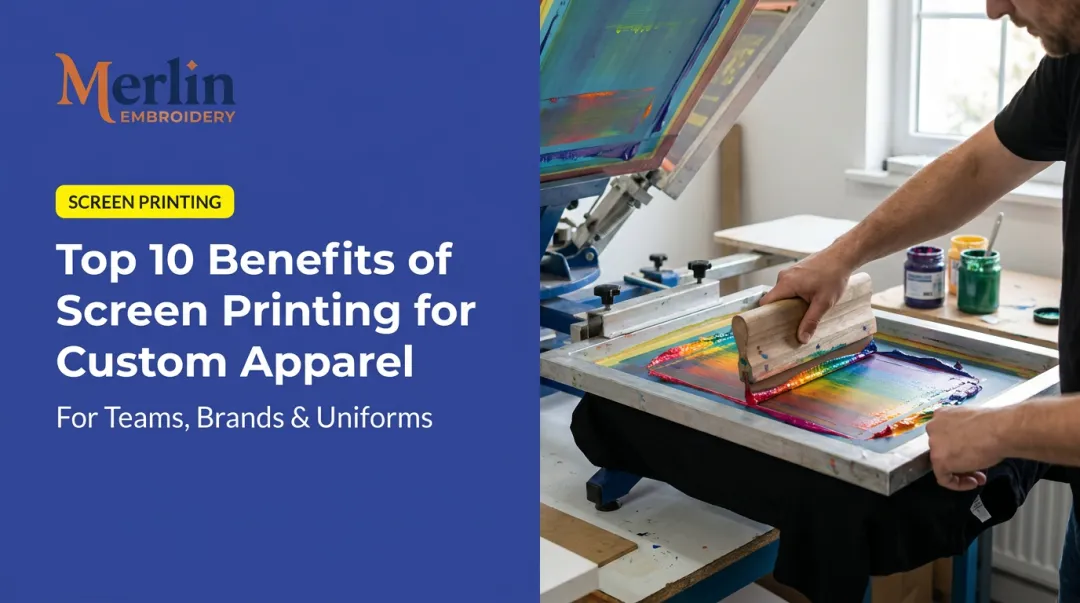
Screen printing pushes ink through a mesh stencil (one screen per color) directly onto the fabric surface. The ink sits on top of the garment rather than absorbing into it, creating a vivid, slightly raised print that cures under heat into a durable layer.
Core advantages:
- Opaque, vibrant colors that perform well even on dark fabrics
- Lowest cost per unit at volume once setup costs are spread across a larger run
- Well-suited for specialty inks: metallic, puff, water-based, and high-density options
- Handles workwear and uniforms that endure frequent industrial washing
Key constraints:
- Each color requires its own screen , so more colors means higher setup costs
- According to PPAI's decoration guide, screen printing is best suited for one- to two-color designs; additional colors increase both complexity and price
- Minimum order quantities typically apply due to screen preparation costs (often 12–24 pieces)
- Complex gradients require halftone techniques, which can limit the effect compared to DTG
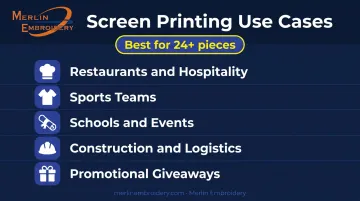
Use Cases for Screen Printing
Screen printing works best for bulk orders with consistent, bold designs, where setup costs become negligible at scale.
Best fits include:
- Restaurants and hospitality staff ordering dozens of matching shirts at a predictable per-piece cost
- Sports teams running high-volume uniform orders with 1–4 color logos
- Schools and event organizers printing hundreds of shirts for a single occasion
- Construction and logistics crews needing durable, affordable workwear that holds up to constant washing
- Promotional giveaways where price-per-piece is the deciding factor
What Is Embroidery?
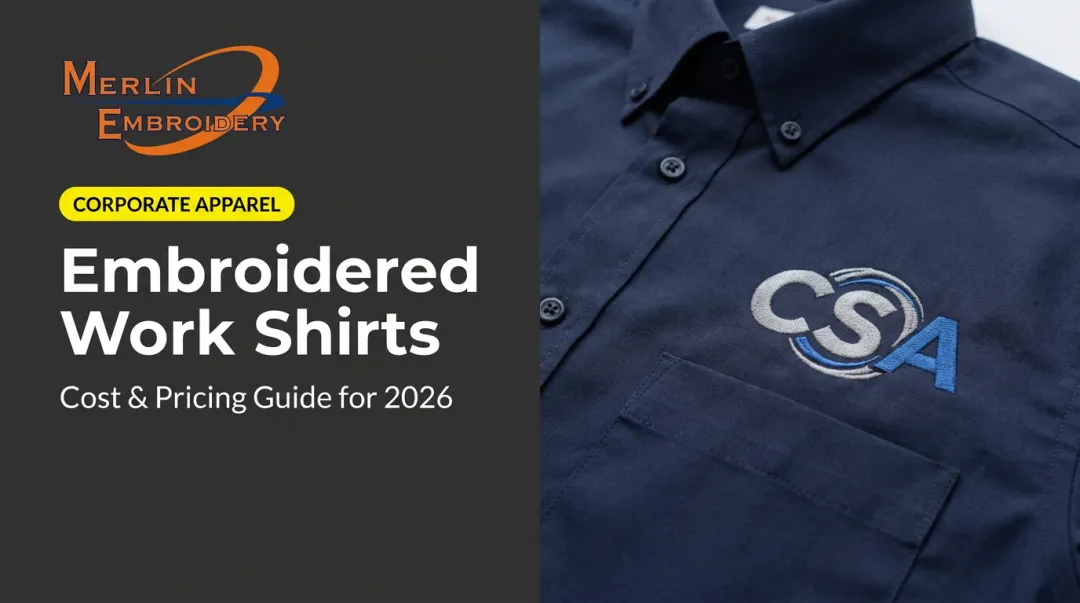
Embroidery stitches your design directly into the fabric using thread. A digitized file tells the machine exactly where each stitch goes, in what color, and at what density — so the result isn't an applied layer, it's part of the garment's physical structure.
Defining advantages:
- Thread doesn't crack, fade, or peel — it outlasts the garment in most cases
- Raised, three-dimensional texture signals quality and professionalism on sight
- Works across virtually any fabric: cotton, polyester, fleece, structured outerwear, and more
- A single digitizing fee covers unlimited future runs of the same design
Design limitations:
- Very fine details, thin lines, and color gradients are difficult to reproduce in thread
- Large designs with high stitch counts increase cost significantly
- Not the right tool for photorealistic imagery or artwork with subtle shading
For businesses in San Diego and La Mesa, Merlin Embroidery brings over 30 years of regional experience to every order. Their standard work is built to 50+ wash durability — a spec that matters when uniforms go through commercial washing five days a week.
Use Cases for Embroidery
Embroidery is the clear choice when the apparel needs to represent the organization at a professional level, day after day.
Industries that rely on embroidery most:
- Corporate offices — branded polos, button-downs, and jackets for client-facing staff
- Healthcare — scrubs and uniforms that endure daily commercial washing
- Hospitality — front-of-house staff apparel where appearance standards are high
- Schools and teams — uniforms and spirit wear that need to survive a full season
- Construction and safety — durable logos on high-visibility gear and outerwear
Which Decoration Method Is Right for Your Business?
Four factors should guide this decision: design complexity, order volume, garment type, and how the apparel will actually be used.
Choose DTG When:
- You need 50 or fewer pieces with no setup cost
- Your design has multiple colors, gradients, or photorealistic elements
- Garments are 100% cotton or high-cotton blends
- You need fast turnaround on a small run, or want to test a design before scaling
Choose Screen Printing When:
- You're ordering 24+ pieces with a consistent design
- Your artwork is bold and simple — 1 to 6 solid colors, no gradients
- You need the lowest possible per-piece cost across a large run
- The apparel is for staff uniforms, event shirts, or promotional giveaways where volume drives value
Choose Embroidery When:
- The garment is structured — a polo, jacket, cap, or fleece — where raised texture adds perceived quality
- The apparel needs to withstand daily washing without degrading (healthcare, hospitality, corporate uniforms)
- The goal is brand prestige and longevity, not design complexity
- You want a decoration that lasts the lifetime of the garment
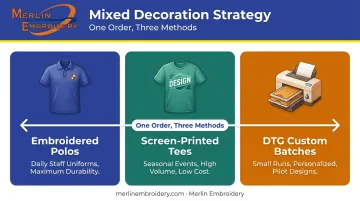
Mixing Methods
Many organizations don't choose one method — they use all three strategically:
- Embroidered polos for management and front-line staff who wear them daily and need lasting durability
- Screen-printed T-shirts for seasonal events or high-volume promotional runs where bold graphics and low cost per piece matter
- DTG for small custom batches — pilot designs, personalized gifts, or low-quantity one-offs
Working with a provider that handles embroidery and screen printing under one roof eliminates the hassle of managing multiple vendors per order. If you're in San Diego, La Mesa, or Los Angeles, Merlin Embroidery offers both services with a 5–10 day turnaround — typically 20–25% more affordable than regional competitors — so you can mix methods across your order without the back-and-forth of coordinating separate vendors.
Frequently Asked Questions
How does DTG compare to screen printing and embroidery in quality for streetwear?
For streetwear, DTG handles photorealistic and multi-color graphic prints best. Screen printing excels for bold, logo-based designs at volume. Embroidery signals premium quality on structured pieces like caps and outerwear. The right choice depends on whether your streetwear identity is graphic-forward or logo-driven.
Do customers prefer DTF or DTG for streetwear prints?
DTG produces a softer hand-feel on cotton, which most streetwear buyers prefer for T-shirts. DTF (Direct-to-Film) offers better durability on synthetic fabrics and works across a wider range of garment types.
Which decoration method is most durable for work uniforms?
Embroidery is the most durable option — stitched thread doesn't fade, crack, or peel regardless of washing frequency. Screen printing with plastisol ink is a strong second choice for high-volume uniform programs where budget is the primary constraint.
Is embroidery more expensive than screen printing?
Embroidery involves a one-time digitizing fee plus per-unit costs tied to stitch count, making it higher per-piece than screen printing for large orders. That said, embroidery's longer lifespan and premium appearance often justify the cost for corporate, healthcare, or professional uniforms.
Can embroidery and screen printing be combined on the same order?
Yes — many organizations order embroidered staff polos alongside screen-printed event tees within a single project. Merlin Embroidery handles both in-house, so you get consistent quality and a single point of contact for the entire order.
What is the typical minimum order for screen printing versus embroidery?
Screen printing minimums typically start around 12–24 pieces due to screen setup costs. Embroidery can be done at lower quantities — the digitizing fee is paid once and applied to all future orders, making reorders cost-effective regardless of size.